
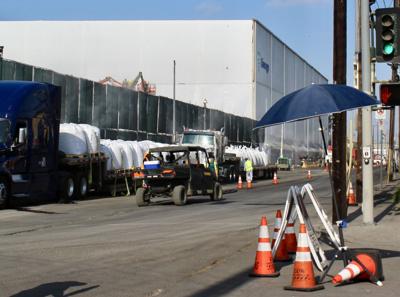


Outside the Lineage Logistics on Wednesday. Photo by Brenda Verano
Local small business and nonprofit organizations affected by the Lineage Fire are now eligible for federal loans of up to $2 million.
Even if they did not sustain physical damage due to the fire, businesses and nonprofits can apply for the loan if they were economically affected by the fire’s aftermath.
Loans
Residents and community organizations can receive loans of up to $2 million with interest rates as low as 4% for businesses and 3.6% for nonprofits.
In addition, interest will not accrue or accumulate and repayment of the loans begins a year after the initial disbursement.
The fire, which ignited on June 17 at the nearly 500,000-square-foot warehouse, has since prompted emergency declarations from both L.A. Mayor Karen Bass and Governor Gavin Newsom.
“The Boyle Heights community has endured tremendous disruption, and we moved quickly to bring every available resource to bear. These loans will help local businesses and nonprofits meet essential costs, retain workers and move forward as the community recovers,” Newsom said earlier in the week, when he announced the loans.
Latino workers and businesses
According to a study published by the UCLA Latino Policy and Politics Institute in June, two-thirds of jobs in the initial smoke advisory zone are held by Latinos.
That number can be much bigger, since, as the institute explained, the Lineage Fire impacts have extended beyond the initial advisory zone area into surrounding neighborhoods.
Many small business owners like Janet Cerda, owner of Cafe Niña, a coffee shop and community hub in Boyle Heights, had to close her shop for weeks after the fire began. In June, she told CALÓ News she was worried about the economic impact the fire would cause to her business. “We can't afford to close,” she said. “I would step into my storefront and I would feel dizzy and sick to my stomach. My eyes were burning. I knew it was bad.”
Like Cerda, many residents' jobs required on-site presence, something that was compromised by the ongoing air and fire exposure. Community organizations have also argued that small businesses in retail, accommodation and food service experienced a steep decline in clients who do not want to be exposed to smoke, the majority of whom were owned by Latinos.
Disaster declaration
The federal funds were made possible after the U.S. Small Business Administration (SBA) approved Newsom’s request for a disaster declaration, which led to the creation of low-interest federal loans.
The disaster declaration covers Kern, Los Angeles, Orange, San Bernardino and Ventura counties.
“Recovery depends on getting practical assistance to communities as quickly as possible. [The] California Governor’s Office of Emergency Services requested this declaration so affected businesses and nonprofits can access additional support to meet essential costs and continue serving the Boyle Heights community,” Caroline Thomas Jacobs, director of California's Office of Emergency Services, said. “We will continue working with L.A. and our federal partners to connect eligible organizations with the resources they need to recover.”
These loans are also available to small agricultural cooperatives and faith-based organizations that experienced financial losses directly related to the fire. Agricultural producers, farmers and ranchers are not eligible, except for aquaculture enterprises.
The state said the funds may be used to pay fixed debts, payroll, accounts payable and other expenses that could not be paid because of the disaster.
More than money: a health crisis
On August 18, the same day that the federal loans were announced, a new study published by St. John’s Community Health reported on the severe and ongoing health impacts of the fire that were seen through their mobile clinics.
St. John’s Community Health, which, along with community organizations like Inner City Struggle and Inclusive Action, handed out air purifiers and N95 masks throughout the day following the fire, said that people who live and work near the Lineage cold storage warehousecould face severe and worsening health risks.
According to their study, 36% of patients served met surveillance criteria directly related to toxic exposure and smoke inhalation, including acute upper respiratory infections, eye disorders and conjunctivitis, persistent cough, asthma exacerbation and other respiratory conditions and distress. Of the 36% of affected patients, 92% were Latinos and 64% were 50 years or older.
In addition, St. John’s Community Health also stated that dozens of their patients were prescribed anxiety or sleep medication to treat acute stress post-fire, which was related to insomnia, housing instability, lease termination requests, relocation concerns or ongoing uncertainty regarding environmental safety and psychosocial distress associated with displacement and recovery.
Jim Mangia, president of St. John’s Community Health, said people are paying attention to the short- and long-term health impacts of the warehouse fire.
“When disasters happen in working-class neighborhoods like Boyle Heights, there’s often a sense it can be swept under the rug,” he said. “The fire may be out, but its effects continue to be a serious public health concern that needs serious attention, intervention, accountability and action from Lineage Logistics.”
According to Bass and councilmember Ysabel Jurado, Lineage has not confirmed a definitive date on when all the rotten food will be cleaned up.
How to apply
For those interested in the loans, representatives of the U.S. Small Business Administration will be available at two local centers to answer questions and assist with applications. The locations include the East LA/Boyle Heights Business Source Center and the East LA Entrepreneur Center (Centro Maravilla).
As of today, walk-ins are welcome, but appointments may also be scheduled at: appointment.sba.gov/schedule/.
The deadline to apply for an Economic Injury Disaster Loan is May 14, 2027.




(0) comments
Welcome to the discussion.
Log In
Keep it Clean. Please avoid obscene, vulgar, lewd, racist or sexually-oriented language.
PLEASE TURN OFF YOUR CAPS LOCK.
Don't Threaten. Threats of harming another person will not be tolerated.
Be Truthful. Don't knowingly lie about anyone or anything.
Be Nice. No racism, sexism or any sort of -ism that is degrading to another person.
Be Proactive. Use the 'Report' link on each comment to let us know of abusive posts.
Share with Us. We'd love to hear eyewitness accounts, the history behind an article.