
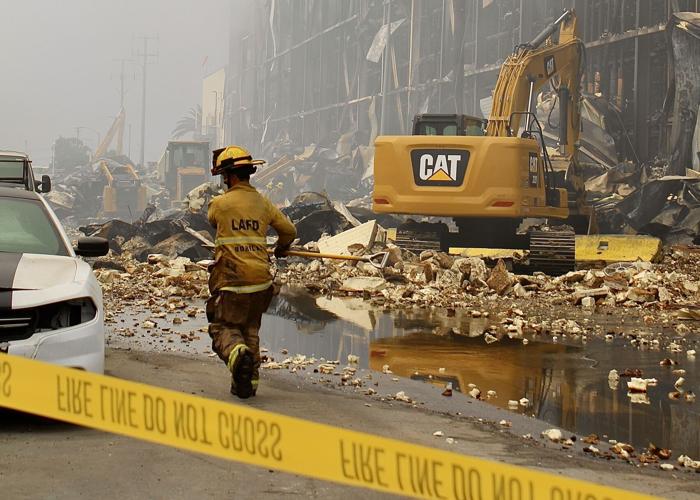


Firefighters at the Lineage Fire. Photo by Brenda Verano
The California State Senate is currently considering a proposal to impose new regulations on cold storage facilities following the Lineage Fire that broke out in Boyle Heights in June.
Assemblymember Mark González, a Democrat representing Boyle Heights, introduced AB 817 in response to the warehouse fire that blazed on for over a week and still has roughly 88 million pounds of food rotting and affecting everyday life for nearby residents.
“My community has been in a situation for almost two months now where residents cannot even live in their homes,” González said during a Monday Senate Local Government Committee hearing. “And when the heat rises and temperature spikes like they are this week, residents can't eat, they can't sleep and they cannot simply even breathe.”
Under the bill, new building permits would not be presented to companies that operate cold-storage facilities unless they show they have a contingency fund of up to $20 million to provide food and housing assistance, air quality monitoring, healthcare and more for residents impacted by disasters like the June fire.
“If you're gonna do business in our community, you better be ready to support it when you mess up,” González said.
AB 817 would also exempt future fire settlement payments for Boyle Heights residents and business owners from state income taxes. If residents choose to pursue legal action, any compensation would not be income, but “compensation for suffering,” González said.
The Senate Local Government Committee passed the bill with a 4-2 party line vote on Monday and on Tuesday the Senate Committee on Revenue and Taxation passed it with a 3-1 vote. AB 817 now heads to the Senate Appropriations Committee and must be passed by the Legislature by Aug. 31 before the end of the legislative session.

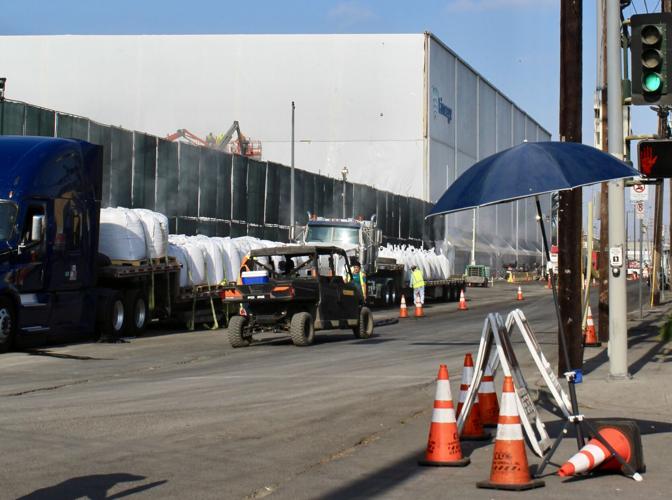
Outside the Lineage Logistics on Wednesday. Photo by Brenda Verano
Lineage, the owner of the warehouse that caught on fire, missed L.A. Mayor Karen Bass’ 45-day deadline to finish cleanup by Aug. 15.
Lineage has committed between $80 to $100 million on cleanup efforts to remove around 88 million pounds of rotting food from the site. The company has donated roughly $2 million to local residents impacted, which González says is not nearly enough.
“We cannot change what happened to Boyle Heights, but we can change what happens next,” Willie Armstrong, Bass’ senior director for state affairs, said Monday.
Meeting the moment
AB 817 looks much different now than it did two months ago – that’s because after the fire broke out, González chose to do a gut-and-amend. That’s when lawmakers change, or essentially “gut” a proposed bill, and “amend,” or replace it with language for another bill that either didn’t pass or didn’t exist. In this case, it was the latter. González’ original bill had to do with public court records.
“We didn’t plan on a fire,” González told CALÓ News. “And my community is hurting… my residents, my neighbors, want to see action now.”
With 28 speakers weighing in one way or another, the bill drew an unusually large turnout, according to CalMatters’ Digital Democracy database. The typical range for non-legislator witnesses is between two and nine, according to the database.
The bill faced opposition from a wide range of industries, including agriculture, dairy and food groups that utilize cold storage and would fall under the bill’s scope.
Katie Little, with the California League of Food Producers, said Monday that in its current form, AB 817 would “discourage investment in new and existing facilities at a time when California's food supply chain already faces capacity challenges.”
Opposition suggested González change the bill language to narrow which companies are subject to the law as well as amend it so that a portion of the proposed contingency funds be used for cleanup efforts. Sen. Jesse Arreguín (D-Oakland), disagreed with this idea.
“I don’t think … that money that should be going to help those who are impacted should be used to clean up the disaster that the company has caused,” Arreguín said.
In response to Monday’s opposition, González told CALÓ News his team is working to narrow down which industries will be subject to the bill’s requirements and that “everything is on the table” as far as the size of the contingency fund. The one thing the assemblymember will not budge on, though, is the requirement for a sizable amount of funds dedicated only to supporting survivors of any future disasters.
“The contingency fund is only in place should a state of emergency occur,” González said. “They just have to pay for their mistakes, and hopefully these companies don’t have these mistakes.”








(0) comments
Welcome to the discussion.
Log In
Keep it Clean. Please avoid obscene, vulgar, lewd, racist or sexually-oriented language.
PLEASE TURN OFF YOUR CAPS LOCK.
Don't Threaten. Threats of harming another person will not be tolerated.
Be Truthful. Don't knowingly lie about anyone or anything.
Be Nice. No racism, sexism or any sort of -ism that is degrading to another person.
Be Proactive. Use the 'Report' link on each comment to let us know of abusive posts.
Share with Us. We'd love to hear eyewitness accounts, the history behind an article.