




Juanmonino/Getty Images
If the Los Angeles City Council leaked recording from 2022 did anything, it dismantled the idea that there is Black and Latino unity in Los Angeles, at least from some of the elected officials.
As the primary election nears, it remains to be seen if Kevin de León will survive the recording scandal where he and several former members of city council were caught saying racist and homophobic remarks.
De León is banking on the fact that he didn’t actually say many of the racists or homophobic remarks in the recording to be re-elected. He has apologized for being silent, but voters will have a final say on whether he has actually been forgiven.
In Tanya Katerí Hernandez’s book “Racial Innocence,” which The American Prospect reviewed, she states that ignoring Latino anti-Blackness undermines the ability to combat racism through public policies, such as anti-discrimination laws and as living in community.
In other words, anti-Blackness has become a tool to continue to perpetuate a division between Latinos, Afro-Latinos and Black people.
Hernandez, who is also a civil rights professor and Afro-Latina herself, wrote after the city council scandal for Time that “moving forward in the pursuit of racial justice will require that we recognize racial innocence for the fiction that it is and unite in educating ourselves about the globality of anti-Blackness.”
In a letter to District 14 voters, De León stated “I’ll always regret not speaking out that day, but I won’t let one mistake stop me from working for every Angeleno in this district.”
The race for district 14 has many contenders and they have been careful not to attack De León, according to a Los Angeles Times article. The same story also mentions Miguel Santiago as the main opponent who has received support from labor unions that once supported De León.
But De León is not the only reason we need to keep addressing anti-Blackness in the Latino community. Ignoring it is not going to make it go away, and confronting it will only help us reach a consensus on how to fight against it.
If we consider that, for example, it wasn't until 2015 that Mexico's census added African descent as a category, it may explain how it is that for many Latinos, Afro-Latinidad wasn't part of their collective conscience.
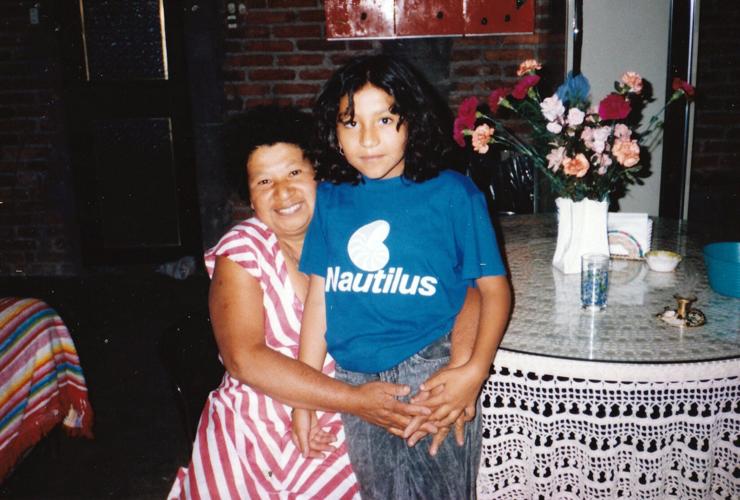
It has only been a few years since I started to wonder if perhaps my paternal grandmother could be Afro Latina. It’s not something that I would be able to ask her because her mind has been affected by my grandfather’s death in 2020. She no longer recognizes who I am. But it is certainly something that I wonder from time to time, as I look at her curly hair and her face features. I wonder if she ever encountered racism in her hometown of Piedras Negras, Veracruz or in Mexico City where she moved and has lived in most of her life.

My paternal grandmother and me.
When I lived in Mexico I didn’t “see” racism at first. I used to think it was mostly classism, but the reality is that colorism and racism are all sides of the same hateful coin. I remember not being admitted to dance clubs because I wasn’t the right color. I remember hearing my relatives talk about a baby as being “prietito pero bonito,” dark but cute.
On Sunday I went to see La Santa Cecilia, and besides crying when La MariSoul sang “Ice El Hielo,” I also cried when she sang “Mi madre es una morena, Morenita nací yo.” (Okay, yes, I am a crier but La MariSoul did cry when she sang “Ice El Hielo” as well).
I love that in many ways music can help us recognize the beauty in our skin color, despite all the centuries of eurocentric beauty standards. Not just music, but other forms of art too. In Karla B. Duarte’s short doc “Sentir el Son,” Franchesca goes through self-discovery of her Afro-Mexican roots. Art is already doing the work to explore the ways we relate with Black and brown skin and cultures. Let’s hope that these elections also bring us more conversations about Black, Latino and Afro-Latino communities in Los Angeles and that we can start working together instead of against each other.








(0) comments
Welcome to the discussion.
Log In
Keep it Clean. Please avoid obscene, vulgar, lewd, racist or sexually-oriented language.
PLEASE TURN OFF YOUR CAPS LOCK.
Don't Threaten. Threats of harming another person will not be tolerated.
Be Truthful. Don't knowingly lie about anyone or anything.
Be Nice. No racism, sexism or any sort of -ism that is degrading to another person.
Be Proactive. Use the 'Report' link on each comment to let us know of abusive posts.
Share with Us. We'd love to hear eyewitness accounts, the history behind an article.