
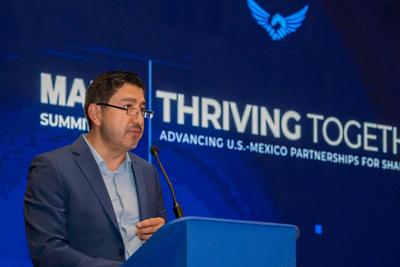


MAPA president and CALÓ News publisher speaking at the MAPA summit. (By MAPA)
Elected officials and leaders from the U.S. and Mexico gathered at the Mexican-American Policy Alliance's (MAPA) 2026 Annual Summit, "Thriving Together: Advancing U.S.-Mexico Partnerships for Shared Prosperity,” to address important issues such as workforce development, health, immigration, education and trade.
MAPA is a bi-national nonprofit organization focused on strengthening the U.S.-Mexico economic and cultural ties, particularly between the U.S. Southwest and Mexico.
The summit took place in Mexico City from July 22 to the 24th, in a timely moment after the U.S. declined to renew the U.S.-Mexico-Canada Agreement (USMCA) on July 1st and the U.S.-Mexico bilateral negotiations resumed in Mexico City the same week.
Therefore, while federal negotiators remain at an impasse, MAPA members believe states and localities can build cross-border economic cooperation from the bottom up.
Binational issues
MAPA members recognized the stakes are enormous now that Mexico is the U.S.'s largest trading partner.
Mexico's Secretary of Finance, Édgar Amador Zamora, said during the summit that the share of Mexican exports moving through the USMCA gateway has risen from 58 percent to 76 percent.
"We have become the United States' largest trading partner. No country sells to the United States more than Mexico, and no country buys from the United States more than Mexico,” he said. "Mexico and the United States share not only a very long border, common history, traditions, culture and cuisine — we also share a common economic fate. The economic relationship between the two countries affects and benefits both."
Dr. Ilian Shapiro, Chief Health Correspondent and Medical Affairs Officer with AltaMed, said health crosses borderlines at any moment. For example, a virus in Tijuana is a virus in San Diego in a matter of days.
“We learned this the hard way through H1N1 and again through COVID,” he said. “What we also learned is the other side of that truth: when the United States and Mexico work as one region, sharing data, training and people, the whole region gets healthier.”
Mike Madrid, Republican national political strategist and author of “The Latino Century,” recognized that MAPA is doing something profound for both countries. Madrid analyzes the politics of the U.S.-Mexico policy while building bipartisan support amid a widening divide.
“The changing Latino voter in the United States and the ascendancy of Latino elected officials promises a new era of bipartisan policymaking that will only be strengthened with allies on both sides of the border,” he said.
He also said what unites Latinos is that in a large part, they are the blue-collar working class of America.
“And when you speak to us as working-class voters, we respond," he said. "The U.S.-Mexico relationship is built across party lines by putting our Latinidad, our Latino identity, ahead of the political system.”
The summit was considered a success and leaders from both sides of the border believe they can work together to better the communities in both countries.
Arturo Carmona, MAPA president and CALÓ News publisher, said there is too much at stake and the economies are too intertwined and too interdependent.
“We can't wait for Washington to act, and we can't sit on the sidelines anymore,” Carmona said.








(0) comments
Welcome to the discussion.
Log In
Keep it Clean. Please avoid obscene, vulgar, lewd, racist or sexually-oriented language.
PLEASE TURN OFF YOUR CAPS LOCK.
Don't Threaten. Threats of harming another person will not be tolerated.
Be Truthful. Don't knowingly lie about anyone or anything.
Be Nice. No racism, sexism or any sort of -ism that is degrading to another person.
Be Proactive. Use the 'Report' link on each comment to let us know of abusive posts.
Share with Us. We'd love to hear eyewitness accounts, the history behind an article.