
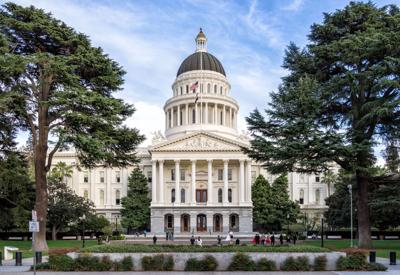


California State Capitol in Sacramento (Andre m / Wikimedia Commons)
Just two days before the 2025-26 California Legislative session came to an end, lawmakers passed a last-minute budget bill that, among other investments, allocates $3 million to ethnic media throughout the state.
Senate Bill 113 was the last of dozens of budget trailer bills that were introduced following the passage of the official 2026-27 state budget in July. The trailer bills are meant to secure additional funding for various sectors that were not agreed on before the governor signed the budget earlier this summer. The allocations were driven by media stakeholders and lawmakers.
“A radio station in the Central Valley may be the only place farmworkers can hear a wildfire evacuation order in Spanish,” said Arturo Carmona, president of Latino Media Collaborative (LMC). “When the federal cuts hit, station managers didn’t know if they’d make payroll through the summer. This $3 million is important as it tells stations California sees them and isn’t going to let them go dark.”
Outlets that primarily serve non-English-speaking communities, communities of color and are considered ethnic media outlets will be considered for the grants, which will come directly from the Governor’s Office of Business and Economic Development. Outlets have until Aug. 31, 2027 to apply.
“In the Central Valley we have a wide array of trusted voices that reach every corner of our community,” said Sen. Melissa Hurtado (D-Bakersfield), one of the lawmakers who worked to secure this investment. “I am proud to have championed increased support for ethnic media outlets, particularly radio, which serve as a vital lifeline of information to our region.”
In addition to the ethnic media allocation, SB 113 also invests $3 million into public broadcasting to address “the loss of federal funding,” the bill reads. The budget trailer bill is now on Gov. Gavin Newsom’s desk.
The investment was championed by LMC, California Black Media and American Community Media. LMC is CALÓ News’ publisher.
Ethnic media outlets will be able to apply for a one-time grant to support operations; five percent of the grant total may be used for administrative costs.
Last summer, Congress voted to eliminate $1.1 billion in already appropriated funds for the Corporation of Public Broadcasting (CPB). The Trump administration also attempted to cut off funding for NPR and PBS, though that order was blocked by a federal judge.
The CPB loss trickled down to public radio and media throughout the country, with at least 550 public media workers losing their jobs since July 2025, according to SemiPublic’s Public Media Layoffs Tracker. That federal funding made up around 8 to 10% of public radio stations’ budgets, according to reporting by NPR.
José Martínez-Saldaña, co-executive Director of Radio Bilingüe, said during a November 2025 Assembly Arts, Entertainment, Sports and Tourism Committee hearing that his team has been working “round the clock” to address this federal loss. Radio Bilingüe is a 16-station network that operates in Spanish, English and Mexican-Indigenous languages.
"Public media is not just programming; it is critical infrastructure: emergency alerts during disasters, educational content for families and children, coverage of local arts, culture and civic life," said Assemblymember Chris Ward (D-San Diego) during the November hearing.
The public broadcasting budget item has slightly more conditions in place. The Office of Business and Economic Development will still distribute the grants, but will work with “relevant fiscal and policy committees” in the Legislature to develop the grant criteria and select the awardees.
Criteria that could be taken into consideration include an outlet’s programming quality, its role in distributing emergency alerts and “demonstrated need,” according to the bill text.
Ethnic programming is crucial for non-English-speaking or marginalized communities who either do not have readily accessible and reliable news, or are overlooked by mainstream media, according to those who championed these investments.
“We reach across generations and also the Latino experience,” Martínez-Saldaña said. “Our audience is considered hard to reach in times like the census and the pandemic, and we help the state of California reach them. Not just to be counted, but to stay healthy.”
Local journalism received another win earlier this year, when the Legislature and governor passed an additional $20 million to support local news organizations through grants up to $250,000.







(0) comments
Welcome to the discussion.
Log In
Keep it Clean. Please avoid obscene, vulgar, lewd, racist or sexually-oriented language.
PLEASE TURN OFF YOUR CAPS LOCK.
Don't Threaten. Threats of harming another person will not be tolerated.
Be Truthful. Don't knowingly lie about anyone or anything.
Be Nice. No racism, sexism or any sort of -ism that is degrading to another person.
Be Proactive. Use the 'Report' link on each comment to let us know of abusive posts.
Share with Us. We'd love to hear eyewitness accounts, the history behind an article.