


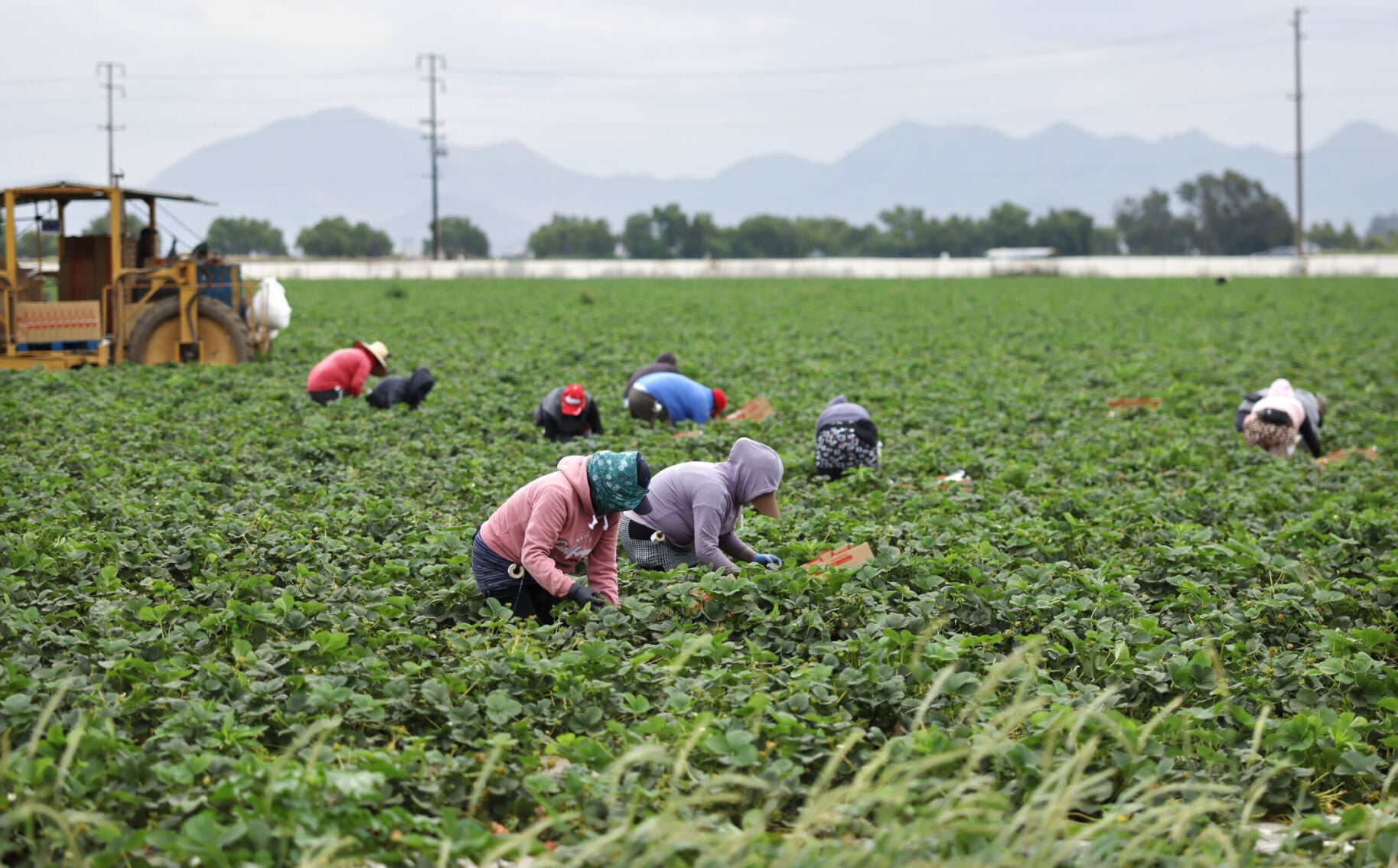
Farmworkers harvest strawberries in a field near Oxnard, California. Photo: Mario Tama/Getty Images.
This article was produced by Capital & Main. It is published here with permission.
California Gov. Gavin Newsom has an opportunity this month to do two things at once: reaffirm his support of higher wages for low-paid workers, and stick his thumb in the eye of President Donald Trump’s systematic attack on immigrants.
Will Newsom seize the moment? It’s there for him if he wants it.
Sitting on the governor’s desk is legislation that would increase the minimum wage for many farmworkers to a mandatory $19.75 an hour beginning next year. The bill, already approved by the state Legislature, was written specifically to override a U.S. Department of Labor decision from last fall that dramatically lowered pay for “H-2A” farmworkers — immigrants on temporary or seasonal work visas. Those workers numbered about 35,000 in California and nearly 400,000 across the country last year.
The DOL policy cut their average hourly wages from an estimated $19.97 to $16.90 in California, according to data compiled by the United Farm Workers Foundation, an arm of the union that represents many of the workers. Other states have seen even steeper wage drops for H-2A farmworkers as a result of the federal policy shift: a 33% decline in Georgia, 27% in Oregon and 24% in Michigan, among others.
A federal district judge in Fresno last month declared the DOL rule illegal. But those lower wages remain in place nevertheless, and there’s no relief on the near horizon. The judge’s ruling ordered the Labor Department to come up with a new wage calculation, but he did not establish a timetable for action.
The passage of the California bill, authored by Assemblymember Maggy Krell (D-Sacramento), was designed to restore the workers’ wage levels to nearly what they were before the DOL policy was implemented. Proponents say the bill will ultimately benefit hundreds of thousands of farmworkers, since the legislation applies not merely to those on temporary visas but to anyone who performs similar agricultural tasks.
The wage law would only affect the Golden State, of course. But if it’s signed by Newsom and survives a promised legal challenge by farm operators, it could become a template for states that want to push back on the Trump administration’s assault on immigrants, including those who work the nation’s fields.
* * *
As is his habit, Newsom has taken no public position on the legislation. A spokesperson for the governor, Diana Crofts-Pelayo, said his office doesn’t typically comment on measures that are awaiting his signature.
But Newsom has waded hip-deep into past efforts to raise the pay of low-wage workers in California. The governor in 2023 helped broker the $20 per hour fast food wage law negotiated by worker unions and the fast food industry. That same year, after initially expressing reluctance on the specifics of a raise to $25 an hour for hundreds of thousands of health care workers, Newsom signed a revised version of the bill that phased in that figure over a number of years.
This March, while declaring “Farmworkers Day” in the state, Newsom decried “cruel and aggressive immigration actions that terrorize and hurt farmworkers and their families,” a reference to the Trump administration mobilizing an essentially military-style crackdown on immigrants in California. It was an open acknowledgement of the truth that an estimated 90% of the state’s nearly 900,000 farmworkers are immigrants, many of them on temporary visas or without work authorization at all.
Trump’s Department of Labor took aim specifically at the H-2A workers in its policy last fall, altering the way that such workers’ wages are calculated by categorizing almost all of them as “unskilled.” The resulting lower pay scale would save farm operators about $2.5 billion a year in wages, the department estimated — essentially, a direct transfer of that much money from farmworkers’ pockets to employers’ bank accounts.
It was a tortured logic. By the administration’s own reckoning, Trump’s anti-immigrant policies have resulted in fewer available farmworkers — a self-created problem federal officials tried to fix by making it cheaper to hire immigrant labor on a temporary basis. But U.S. District Judge Kirk E. Sherriff found that the Labor Department needlessly rushed the H-2A wage policy into place, and didn’t solicit public comment.
In declaring the policy illegal, Sherriff allowed the new, lower wage scale to stay in effect temporarily. Sherriff ordered the Labor Department to “promptly produce” a new method for calculating the wages of H-2A workers, though what “promptly” means is open to wide interpretation.
In the meantime, Krell’s bill, introduced in February, passed the state Assembly and Senate largely on strong Democratic support. Farm industry groups and trade associations have loudly opposed the measure from the start, saying employers cannot afford more expensive labor amid other rising costs, and they’ve all but promised a legal battle if Newsom signs it into law.
The bill “invites litigation,” wrote Jason Resnick, senior vice president and general counsel for the agricultural trade association Western Growers, arguing that California’s attempt to override federal policy on the wage issue is likely a question for the courts. Resnick suggested that Western Growers will be one of multiple farm industry organizations joining together to mount a legal challenge.
* * *
The pending state legislation aside, California has already opposed the Department of Labor’s action. State Attorney General Rob Bonta co-led a coalition of 13 attorneys general in supporting the United Farm Workers’ lawsuit that produced Sherriff’s decision last month, and Bonta last year opposed federal measures that he said would strip critical safeguards and protections for farmworkers on temporary visas.
The Trump administration’s response to the court challenge was muddled. Appearing before Sherriff earlier this year, a lawyer for the administration, Alexandra McTague Schulte, acknowledged that “there aren’t enough Americans to take these jobs.” Yet Schulte refused to agree with Sheriff’s suggestion that lowering wages for workers on temporary visas would ultimately undercut the market for all farmworkers, including those with U.S. citizenship, as those lower wages would soon become the norm.
Federal policy prevents farmworkers, including those with temporary visas, from being paid below a state’s posted minimum wage. California’s potential new law is different: It actively sets those workers’ wages well above the current state minimum of $16.90 per hour, and it ties future increases to inflation.
That’s not even really a win for the workers, who’d been averaging more than the new $19.75 wage under the previous Department of Labor calculation for those on temporary visas. Rather, California finds itself once again trying to fend off a Trump administration attempt to make life worse for immigrants — and, ultimately, for the others working beside them in the state’s farm fields.






(0) comments
Welcome to the discussion.
Log In
Keep it Clean. Please avoid obscene, vulgar, lewd, racist or sexually-oriented language.
PLEASE TURN OFF YOUR CAPS LOCK.
Don't Threaten. Threats of harming another person will not be tolerated.
Be Truthful. Don't knowingly lie about anyone or anything.
Be Nice. No racism, sexism or any sort of -ism that is degrading to another person.
Be Proactive. Use the 'Report' link on each comment to let us know of abusive posts.
Share with Us. We'd love to hear eyewitness accounts, the history behind an article.