
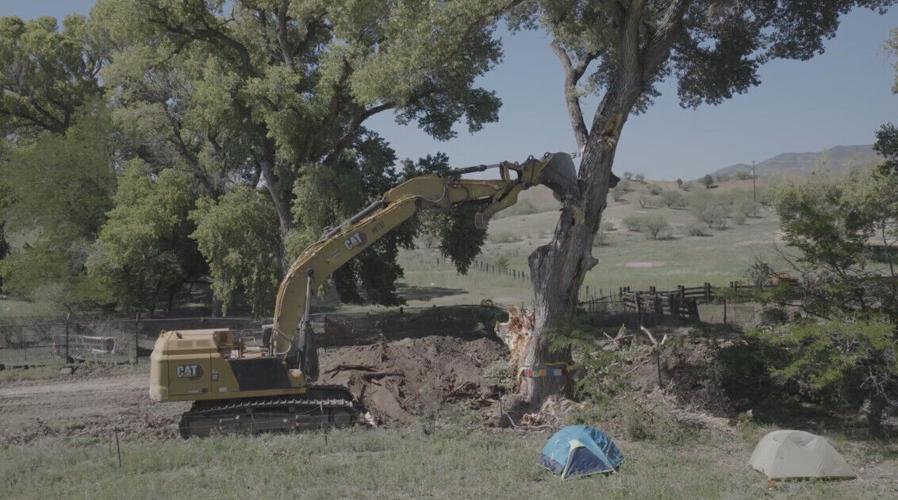
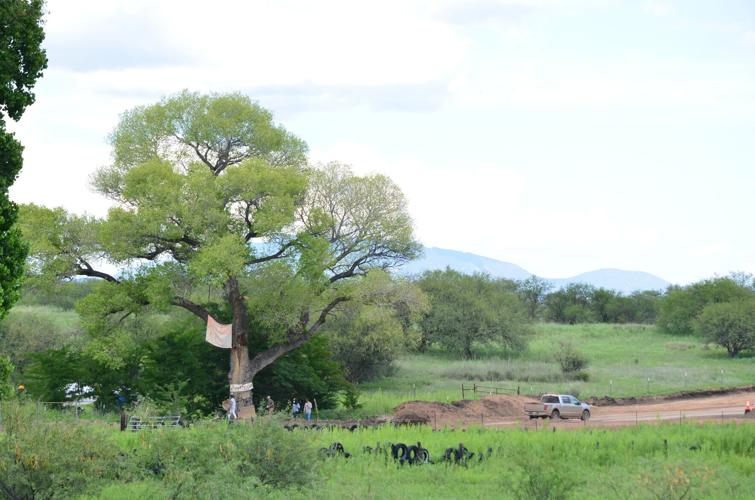

Activists protest the destruction of grandmother trees in Lochiel, Arizona, where the Trump administration is building a border wall between the U.S. and Sonora, Mexico. (Courtesy of John Kurc and the Center for Biological Diversity)
Lochiel, Ariz. – In southern Arizona, border wall construction has triggered an environmental protest in which activists and citizens have gathered around and atop a grandmother cottonwood tree, trying to prevent it from being felled as part of work on the new structure that will divide Mexico and the United States.
Three large cottonwood trees have already been cut down.
The protest, which began in late July, is taking place in Lochiel, a small community in the San Rafael Valley bordering the Mexican state of Sonora. Activists call the cottonwood tree they are defending — located just steps from the border wall — the grandmother tree and estimate it to be between 100 and 200 years old.
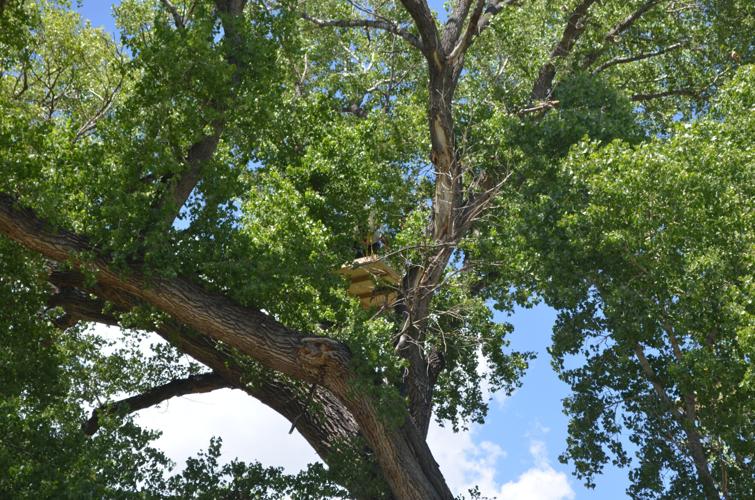
Activists have maintained a 24-hour presence in the area, camping out while someone climbs to the top of the cottonwood. They rigged the tree for climbing and installed a platform — a simple board — where a person can sit. They take turns ensuring someone is always stationed at the top.
On Aug. 17, the protest took on a binational character after a group arrived on the Mexican side, in the small municipality of Santa Cruz, Sonora. They set up camp, and a person climbed a cottonwood tree in Mexican territory — a tree also at risk of being cut down.
"Activists have occupied this tree to try to protect it and prevent it from being cut down," said Erick Meza, the border coordinator for the Sierra Club, who was present at the recent protest. He told CALÓ News that for months they have been trying to draw attention to the importance of this migratory corridor for the bird and mammal species inhabiting the area.

Activists protest the destruction of grandmother trees in Lochiel, Arizona, where the Trump administration is building a border wall between the U.S. and Sonora, Mexico. (César Barrón/CALÓ News)
They unsuccessfully attempted to negotiate with the Department of Homeland Security (DHS) to prevent the cutting down of some of the oldest trees in the area.
“We understand the need for border security, but not at the cost of sacrificing the few precious resources we have left, such as our natural environment and the beautiful community that has existed here for generations,” the Sierra Club border coordinator said.
Fisher Sand & Gravel Company is carrying out the project, which was contracted to erect a 30-foot-high wall spanning 27 miles. According to U.S. Customs and Border Protection (CBP) data, the investment exceeds $300 million. Construction is scheduled to continue through 2027.
He believes these actions could lead to negotiations with the government to save the trees. The goal is clear: as long as someone remains in the cottonwood tree, protesters hope to prevent it from being cut down.
During a visit to the area by CALÓ News, activists could be seen on the U.S. side with their faces covered to avoid identification. They are selective about speaking to the media and some mentioned that they are independent and do not belong to any organization.
They communicate via radio from the camp they have set up beside the cottonwood tree, while large machinery from Fisher Sand & Gravel Company operates on the other side of it. Supplies such as food and water are hoisted up to the person in the tree using a bucket and rope. In May 2025, activists and residents from Sonora and Arizona gathered at that same spot to protest the start of construction to extend the wall by a 36-mile stretch and include three projects in Arizona, including the San Rafael Valley.

Activists protest the destruction of grandmother trees in Lochiel, Arizona, where the Trump administration is building a border wall between the U.S. and Sonora, Mexico. (César Barrón/CALÓ News)
Since then, various actions have been taken to protest the wall's construction and its negative impact on both people seeking to cross into the U.S. and the species inhabiting the area.
On July 27, Meza issued a press release reporting the felling of cottonwood trees without environmental monitors present, as well as the arrest of an individual who opposed the tree-cutting.
Meza cited a letter from CBP in which the agency pledged to designate monitors who would "conduct a pre-construction inspection" and coordinate with relevant federal agencies to avoid "disturbing or harming any migratory bird" or their nests.
Nesting was underway when the contractor cut down the first trees, the statement says, adding that while the trees were being felled, a protester who wanted to ensure environmental monitors were on site was arrested by Santa Cruz County Sheriff's deputies.








(0) comments
Welcome to the discussion.
Log In
Keep it Clean. Please avoid obscene, vulgar, lewd, racist or sexually-oriented language.
PLEASE TURN OFF YOUR CAPS LOCK.
Don't Threaten. Threats of harming another person will not be tolerated.
Be Truthful. Don't knowingly lie about anyone or anything.
Be Nice. No racism, sexism or any sort of -ism that is degrading to another person.
Be Proactive. Use the 'Report' link on each comment to let us know of abusive posts.
Share with Us. We'd love to hear eyewitness accounts, the history behind an article.