
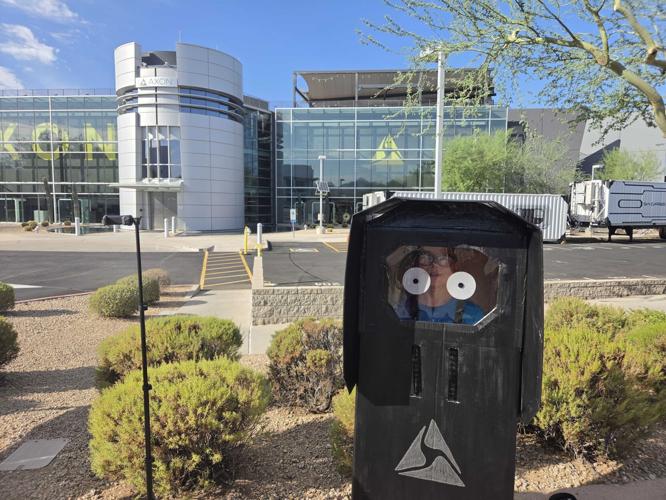


A boy dressed up as an Automatic License Plate Recognition (ALPR) joins a protest in front of the Axon Enterprise headquarters in Scottsdale, Ariz. (Analisa Valdez/CALÓ News)
The poles are lining the streets, the dots on tracking maps are becoming more crowded and concerns surrounding the AI-powered cameras being installed nationwide are continuing to grow as mass surveillance systems take the nation — including Arizona — by storm.
Amid discussions and debates over privatized mass surveillance technology funded and contracted by local governments in metro Phoenix, more concerned citizens and non-profit organizations are blowing the whistle on the real dangers posed by the Automatic License Plate Recognition (ALPR) systems being deployed across the Valley.
In mid-August, East Valley Unite — a pro-democracy, community-based non-profit organization and staunch anti-ALPR advocate — sent out a mass call for East Valley residents to give mass surveillance tech companies a “taste of their own medicine” at a Saturday morning protest.
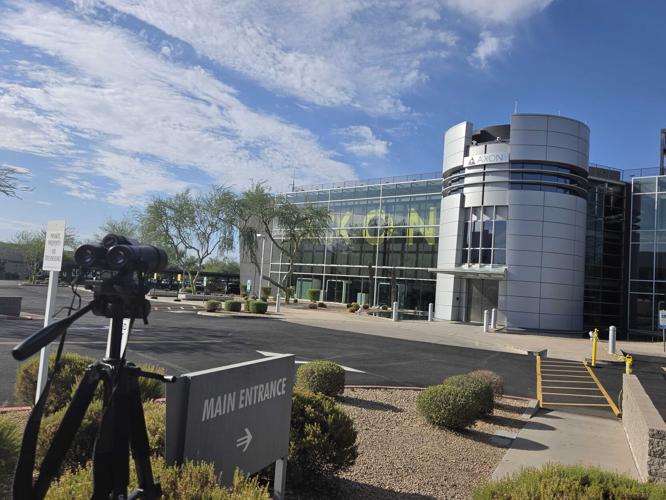
The call drove a handful of protesters to the Axon headquarters building in north Scottsdale, donning binoculars, notepads, cameras and face coverings to watch, survey and disavow the tech industry’s development of ALPR systems being used by local and federal law enforcement agencies.


After some of Arizona’s major cities took steps to manage and limit collaboration with ICE, some immigrant-rights advocacy groups are voicing concerns regarding the confidentiality behind government-sponsored reporting forms
“What we see with ALPRs is that it’s warrantless mass surveillance and Axon is one of the biggest companies facilitating this mass surveillance system,” Nathan Taylortaft, the co-director of East Valley Unite, said. “We’re here… to just watch their activities, take notes — just like they do with us — to bring attention to Axon.”
Axon Enterprise is one of the many tech companies at the forefront of debates surrounding government contracts and investments in developing systems and equipment used to surveil U.S. citizens, such as body-worn cameras used by law enforcement officers and license-plate readers.
East Valley United is one of dozens of organizations calling for local governments to end their contracts with companies like Axon.
“We want ordinances passed ending all ALPR use from any company and that’s why we’re here at Axon’s headquarters today, because it’s not just Flock [Safety]; it’s also Axon and Genetec and Leonardo and all these other companies,” Taylortaft said. “There’s so much energy around Flock, and a lot of people don’t realize that other companies are doing the exact same thing with ALPRs.”
This protest follows Chandler City Council’s recent ruling to discontinue its use of 40 fixed-camera ALPRs powered by Flock Safety. The decision came after a city audit found that a Chandler police officer had misused the surveillance system to locate a family member. The officer later resigned after admitting to the misuse.


“The City of Chandler maintains the highest standard of public trust, transparency and accountability… For the first time in three years, our routine audit process identified an anomaly in the use of the Flock system that could not be explained through standard police action,” the City of Chandler’s statement reads, citing the flagged misuse of Flock data. “Although Chandler’s access to the system will be terminated, the 40 fixed-camera ALPRs and poles are the property of Flock Group, Inc. The removal of that equipment will be performed as quickly as possible by the vendor.”
This officer’s case is one of hundreds being documented by the Institute for Justice, a nonprofit, public interest law firm. A map recently launched by the nonprofit shows nationwide incidents in which local law enforcement misused and abused ALPR camera data to track and invade the privacy of individuals not accused of or committing any crimes. At least three other incidents have been reported in the state.
Around the same time that Chandler moved to distance itself from Flock, the city of Tempe announced that its police department would stop sharing data captured by Flock-installed cameras lining city streets “to ensure community data privacy.” The city was seeking contracts with other surveillance technology companies, keeping the use of license-plate readers in place.
“There was a news article this past week about Youngtown; they have one street that has 40 cameras on it— 40 cameras— and they showed them from an aerial view, and there’s just one long line of cameras just watching everybody… It’s just an intrusion. It’s a huge intrusion. This is a free country. We used to point to countries like China and say, ‘Oh, look, this is a surveillance society, and they watch what everybody does.’... We’re becoming that, and that is not America,” Tom D., one of the Axon HQ protestors and proclaimed U.S. veteran, said. “[ALPRs] track what it is you buy, where you shop, where you go, what you do. That's not a free society, you know. This is like an assumption of guilt and they're going to find a way to charge you with something if they wanted. And I think we have some evidence already that they're doing that — the government is doing that.”

Protesters set up binoculars to keep an eye on Axon Enterprise, the company that builds Automatic License Plate Recognition (ALPR) in Scottsdale, as a protest against mass surveillance tech being used in Phoenix. (Analisa Valdez/CALÓ News)
In addition to strong concerns and arguments being expressed regarding the invasion of privacy these surveillance systems pose, some protesters admitted to seeing some of their worst fears realized as reports of ALPRs being used for stalking, tracking and misidentifying people are becoming more apparent.
While Flock Safety rolled out safeguards for their ALPRs to track how and why their cameras are being used by law enforcement agencies — capable of accessing Flock data without warrants to track suspects of committed crimes — these safety features and agency audits have brought forth the exact situations and dangers posed by its critics, like the incidents in Arizona.
“It’s like a complete cycle. They gather data, they try you, they put you in prison. Everywhere along the line, somebody's profiting off of that,” Tom D. said. “The surveillance side of it is — to me, as a military veteran — reprehensible.”
Earlier this month, three former Georgia police officers were arrested and charged for stalking after illegally using Flock data to track people whom they had a “personal relationship” with. In a Washington Post investigation into the misuse of the Flock system, one police chief allegedly searched his ex-girlfriend’s license plate over 500 times and sent messages that indicated he knew her location. Last year, a Texas sheriff’s office ran a coast-to-coast search across over 83,000 ALPR cameras to track down and attempt to charge a woman who sought an abortion in another state.


The United States is rapidly building what it calls a “smart wall” on the Mexico border, combining tall steel fencing with advanced technology like sensors and cameras
There’s also been an increased number of reported cases where these AI-based identification systems wrongfully flagged individuals, which led to them being either wrongfully arrested, pulled over, fined or — in extreme cases — held at gunpoint, only to later be found innocent. These errors are attributed not only to the cameras, but the agencies that neglected to verify the information from flawed AI-centered databases.
“This is warrantless mass surveillance. The AI systems make mistakes. There have been wrongful arrests, and most importantly, it goes against our Fourth Amendment rights to privacy,” Taylortaft said. “It’s really all ALPRs. The technology isn’t the problem. It doesn’t stop at one company. It’s not just Flock. It’s not just Axon. It’s all these different companies.”
Analisa Valdez (she/her) is a freelance journalist based in Phoenix. Her reporting includes community & culture, social justice, arts, business, and politics.









(0) comments
Welcome to the discussion.
Log In
Keep it Clean. Please avoid obscene, vulgar, lewd, racist or sexually-oriented language.
PLEASE TURN OFF YOUR CAPS LOCK.
Don't Threaten. Threats of harming another person will not be tolerated.
Be Truthful. Don't knowingly lie about anyone or anything.
Be Nice. No racism, sexism or any sort of -ism that is degrading to another person.
Be Proactive. Use the 'Report' link on each comment to let us know of abusive posts.
Share with Us. We'd love to hear eyewitness accounts, the history behind an article.