
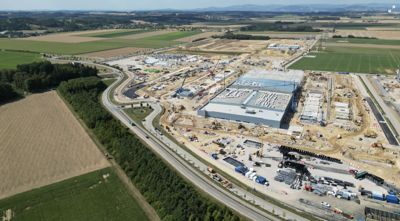


Google Datacenter, Kronstorf, Austria. Photo by Florian Haider.
Democratic candidate for Congress Randy Villegas is calling for a one-year moratorium on new data centers in the Central Valley.
Villegas, who is running to represent California’s 22nd Congressional District, which covers parts of the San Joaquin Valley, including portions of Kern, Tulare, Kings and Fresno counties, has openly talked about the concerns behind the rapid expansion of data centers and the strain they put on local communities.
Although there is no official number, tracking databases estimate California is home to approximately 277 to 296 operating data centers. In the spring, the San Fernando Chronicle reported there were two dozen data centers planned to arrive in California neighborhoods, many of them populated by majority Latino residents.
In the last months, communities like those in Central California have sounded the alarm about the range of potential impacts on the economy, the environment and community infrastructure that data centers and artificial intelligence (AI) pose.
Villegas said the temporary stop on new data center construction in the Central Valley comes at a time when community members are worried about the physical land space data centers take, as well as the water they require to operate and the increased electrical costs often passed on to everyday working people.
“When everything from our healthcare to our groceries to our rent already costs too much, we can't afford to let unchecked big tech developments make life even more expensive,” Villegas said. “A moratorium gives the Central Valley the chance to get this right before it’s too late. No data center should be allowed to raise families’ utility bills, threaten our water supply, exploit our personal data or disrupt local jobs.”
Villegas's call for a one-year moratorium comes ahead of him speaking at a non-partisan town hall in Hanford later this week on proposed data center developments. He is challenging Republican incumbent David Valadao, who Villegas claims has sided with big tech and corporate interests in support of large-scale data center expansion.
As part of the moratorium, Villegas is also calling on the United States Congress to help with the growing concerns. The moratorium includes five standards for Congress to help implement, including making technology companies pay the full cost of the electricity, grid improvements and other infrastructure they require, protecting the Central Valley water supply and guaranteeing good-paying local union jobs, among other things.
According to the Environmental and Energy Study Institute, a medium-sized data center can consume up to roughly 110 million gallons of water per year for cooling purposes, equivalent to the annual water usage of approximately 1,000 households. For larger data centers, the number is much larger. The large data centers can each “drink” up to five million gallons per day, or about 1.8 billion annually, usage equivalent to a town of 10,000 to 50,000 people.
For decades, the Central Valley has struggled with water supply and droughts. The rate of groundwater depletion in the Central Valley has been accelerating since 2003.
Villegas said that for residents in these communities, water resources are crucial for people's daily lives but also for the agriculture that feeds millions of Americans.
The moratorium also calls on Congress to enact strong rules governing how corporations collect and use our data and deploy AI, as well as protecting residents' privacy and putting guardrails on AI.
“Congress must do more to prioritize working people over the tech billionaires and corporate interests making money off of data centers at the expense of working families,” Villegas said.
State and local governments enacting temporary bans, or moratoriums, on new data center construction is not new. New York Governor Kathy Hochul also recently signed an executive order establishing a one-year moratorium on new hyperscale data center permits over 50 megawatts, making it the first state to enact a statewide pause.
Villegas, who was born and raised in the Central Valley and is an auto repair shop owner and a community college professor, said his organizing against the uproar of data centers comes from being part of a working-class immigrant family.
“No data center should be built without the people of the Central Valley having a real say,” he said.





(0) comments
Welcome to the discussion.
Log In
Keep it Clean. Please avoid obscene, vulgar, lewd, racist or sexually-oriented language.
PLEASE TURN OFF YOUR CAPS LOCK.
Don't Threaten. Threats of harming another person will not be tolerated.
Be Truthful. Don't knowingly lie about anyone or anything.
Be Nice. No racism, sexism or any sort of -ism that is degrading to another person.
Be Proactive. Use the 'Report' link on each comment to let us know of abusive posts.
Share with Us. We'd love to hear eyewitness accounts, the history behind an article.