
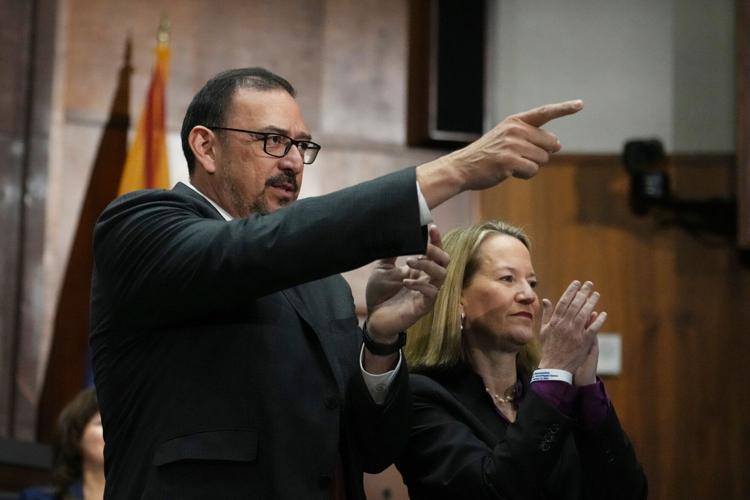

Arizona Secretary of Sate Adrian Fontes, left, and Arizona Attorney General Kris Mayes recognize Arizona Sen. Lela Alston as Arizona Democratic Gov. Katie Hobbs gives her State of the State address in the House of Representatives at the Capitol, Monday, Jan. 12, 2026, in Phoenix. (AP Photo/Ross D. Franklin)
This article was originally published by Votebeat. Votebeat is a nonprofit news organization reporting on voting access and election administration across the U.S. Sign up for Votebeat Arizona’s free newsletter here.
One is a rule-following election administrator. The other is a bomb-throwing election attorney.
That’s the choice voters face in Arizona’s Republican primary for secretary of state. The winner could oversee the high-stakes 2028 presidential race in the state — if they beat Democratic incumbent Adrian Fontes this fall.
In many ways, Gina Swoboda and Alex Kolodin have similar profiles. Both have battled over minutiae of state laws in court, written election policy, and claim to have the support of President Donald Trump.
But the two would take vastly different approaches to the job as the state’s top election official.
Kolodin, a current member of the Arizona House of Representatives, is a teacher-turned-attorney who says voters don’t trust elections. He has heavily criticized election officials, has described existing election systems as dysfunctional, and says he cares more about the will of voters than the concerns of election officials.
The race seems to be getting less attention than the contests for governor, attorney general, and superintendent of public instruction. Swoboda and Kolodin spent much of a televised debate on May 14 delving into fine details of election administration and attacking each other’s backgrounds. Another planned debate was cancelled because of scheduling challenges, leaving voters with relatively scant insight into the candidates’ stances on high-profile election issues.
Kolodin, who did not agree to an interview for this story, has cast Swoboda as a liberal in disguise. He said in May that she was “carrying water” for Fontes.
But Swoboda says Kolodin can’t win a general election and took aim at his legislative connections to the ultra-conservative Freedom Caucus.
Kolodin said in a statement to Votebeat that he was confident in his ability to beat Fontes.
“In November, we will defeat him at the ballot box, restoring confidence for all voters, regardless of party, once and for all,” he wrote.
How Swoboda, Kolodin would run Arizona elections
In Arizona, local officials are in charge of most day-to-day election and voter registration operations in their counties.
But whoever wins the secretary’s post will play a critical role in issuing voluntary guidance to election offices and dictating how voting must be run via the state’s Elections Procedures Manual.
That rulebook, reissued every two years, has the force of law in Arizona — and both Swoboda and Kolodin have called for changes to it.
Swoboda said she would seek to align the manual more closely with state law, noting that Arizona law doesn’t expressly authorize drop boxes for mail ballots. She said she’d push state lawmakers to codify the drop boxes and allocate money to standardize security features for them across counties.
“They will still likely exist, but you can’t have anything in the manual that’s not in Title 16,” she said, referring to the chapter of state statute that governs elections and voting. “The secretary of state should not be taking their personal viewpoints in life and just creating laws in the manual where the Legislature hasn’t done so.”
She also said the current version of the manual allowed voters to provide either their driver’s license number or their Social Security number to meet the minimum requirements for registration. Swoboda said voters should have to provide their driver’s license number if they have one, which would make it easier for election officials to check registrants’ citizenship status.
And she took aim at the manual’s description of activities that might constitute voter intimidation, which currently include “intentionally following individuals delivering ballots to the drop box when such individuals are not within 75 feet of a drop box” and “speaking to or yelling at an individual, without provocation, who that person knows is returning ballots to the drop box and who is within 75 feet of the drop box.” Swoboda said those provisions could infringe on free speech and have “got to go.”
“Our voters demand ironclad election integrity to protect the voice of legal voters, not expansive rules that blur the lines and invite more chaos,” Kolodin wrote.
He also raised issues with Fontes’ assertion that counties must use tabulation machines for the initial counting of ballots, pointing to a line in state law that states that ballots “may be cast, recorded and counted by voting or marking devices and vote tabulating devices” — not “shall.”
“Voters and their local elected officials get to make this decision for their own communities,” he wrote.
At the Capitol, Kolodin has supported legislation to ban vote centers, forcing a statewide return to precinct-style voting, in which voters are assigned to a polling place. He has also sponsored bills to prohibit the state attorney general from prosecuting county supervisors who vote against certifying elections, shorten the early voting period, and require voters to confirm their address each election cycle to vote by mail. And he was the lead author of a November ballot measure that would require mail voters to provide ID, among other changes to state election law.
Swoboda said that she, too, believes the early voting period should be shortened. Voters, she said, shouldn’t be able to drop off their mail ballots on Election Day. Ideally, she’d like to require counties to provide seven days of in-person early voting and reserve mail ballots for those over the age of 65, voters with disabilities, and people with scheduled surgeries or planned vacations during the voting period.

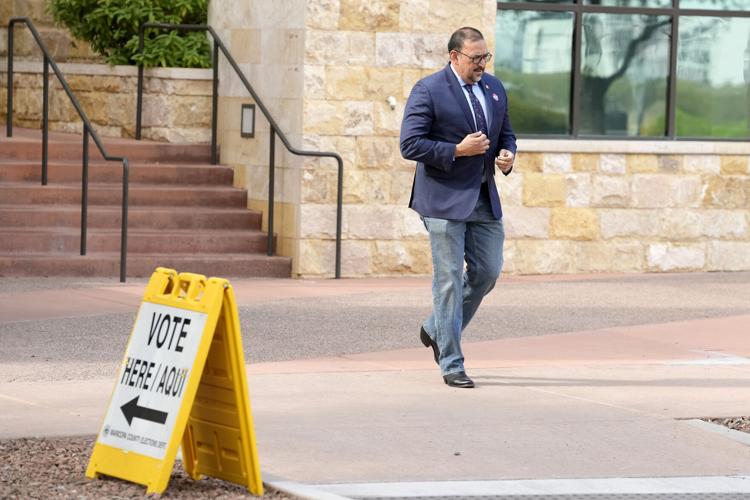
Arizona Secretary of State Adrian Fontes leaves Surprise City Hall after voting on the first day of early in-person voting in the general election Wednesday, Oct. 9, 2024, in Surprise, Ariz. (AP Photo/Ross D. Franklin)
“But that’s up to the voters,” she said, adding that mail voting is wildly popular and that it would take a ballot initiative to significantly change it. “People love it here. People use it here. I’m not interested in taking their choices away unless they themselves wish to limit it.”
Later, she said: “There’s a difference between what I think individually and what I think is proper as a secretary of state.”
Where Swoboda and Kolodin stand on Arizona and the feds
Whoever is elected secretary of state will also decide how far to let the federal government step into the state’s elections.
The race is taking place as Trump has made unprecedented calls to nationalize voting. Under his administration, the U.S. Department of Justice has sued Arizona for access to its full, unredacted voter roll, which includes sensitive information such as voters’ full birthdates and Social Security numbers. The U.S. Department of Homeland Security has encouraged states to use a revamped, unreliable federal immigration tool to identify noncitizens on the voter roll, despite overwhelming evidence that such illegal voters are rare. Meanwhile, several federal agencies appear to be probing the state’s past elections.
Swoboda said she would decline to hand over voter information to the Justice Department, absent a court order. She said local officials should retain control over voter list maintenance.
“I don’t understand why Republicans, who are constitutional conservatives, think it’s a good idea to put the federal government in charge of who is eligible to vote,” she said.
Swoboda previously worked as the executive director of the Voter Reference Foundation, an advocacy group that has raised concerns about voter list maintenance, but stopped short of embracing Trump’s false claims of rigged elections. She praised the updates that federal officials had made to the SAVE system, but said the state should also explore joining EleXa, a new, multistate coalition in which officials compare redacted versions of their voter rolls to look for double voters.
Kolodin said in a June 27 radio interview that he would require county recorders to run their full voter lists through the SAVE system. And in an April interview on the same show, Kolodin heavily criticized a court ruling against the Trump administration’s request for Arizona’s unredacted voter rolls, calling the request “common sense.”
“I don’t know why anybody would want to be delaying making sure that we only have U.S. citizens on our voter rolls,” Kolodin said. “That makes no sense to me.”
As a lawyer, Kolodin previously served as local counsel on a lawsuit claiming “massive, coordinated inter-state election fraud” in 2020. That case was dismissed, along with similar ones filed in other states. Kolodin later faced formal admonishment from the state bar and was assigned five legal ethics classes, including one focused on “meritorious claims and contentions.”
Who can actually win?
The three polls of the race that have been released so far this year show Kolodin in the lead — sometimes within the margin of error, sometimes not — with huge numbers of undecided voters.
The most recent of the group — from NextGen Polling, which surveyed 1,683 likely primary voters last month — put Kolodin at 16% and Swoboda at 11%. Nearly 73% of the electorate said they were undecided.
That suggests the race remains wide open. Several of the polls noted that Kolodin’s support was driven by voters who identified as extremely conservative. Those voters are among the most likely to participate in primaries — and at times, Kolodin has appeared to treat his victory as a foregone conclusion, spending precious minutes in interviews and on the debate stage to repeatedly punch at Fontes.
But Swoboda is betting that she can draw in rural voters. When she was chair of the state party, she said she built strong connections across farther-flung areas of Arizona. She believes primary voters there are open to her message.
“People aren’t going to tell you they’re going to go vote for me,” she said. “They’re just going to go vote for me.”
So far, there’s no polling on how Swoboda or Kolodin might fare against Fontes. But NextGen Polling noted its results suggested moderate voters in the primary preferred Swoboda.
Swoboda called herself “electable,” adding she wasn’t “a highly polarizing person” likely to alienate independent voters and crossover Democrats.
“When there’s a fight to be had, I’m willing to fight,” she said. “But I don’t believe everything is a fight, and I don’t believe that our system is helplessly broken. I do not want to burn it to the ground.”
Sasha Hupka is a reporter for Votebeat based in Arizona. Contact Sasha at shupka@votebeat.org.









(0) comments
Welcome to the discussion.
Log In
Keep it Clean. Please avoid obscene, vulgar, lewd, racist or sexually-oriented language.
PLEASE TURN OFF YOUR CAPS LOCK.
Don't Threaten. Threats of harming another person will not be tolerated.
Be Truthful. Don't knowingly lie about anyone or anything.
Be Nice. No racism, sexism or any sort of -ism that is degrading to another person.
Be Proactive. Use the 'Report' link on each comment to let us know of abusive posts.
Share with Us. We'd love to hear eyewitness accounts, the history behind an article.